
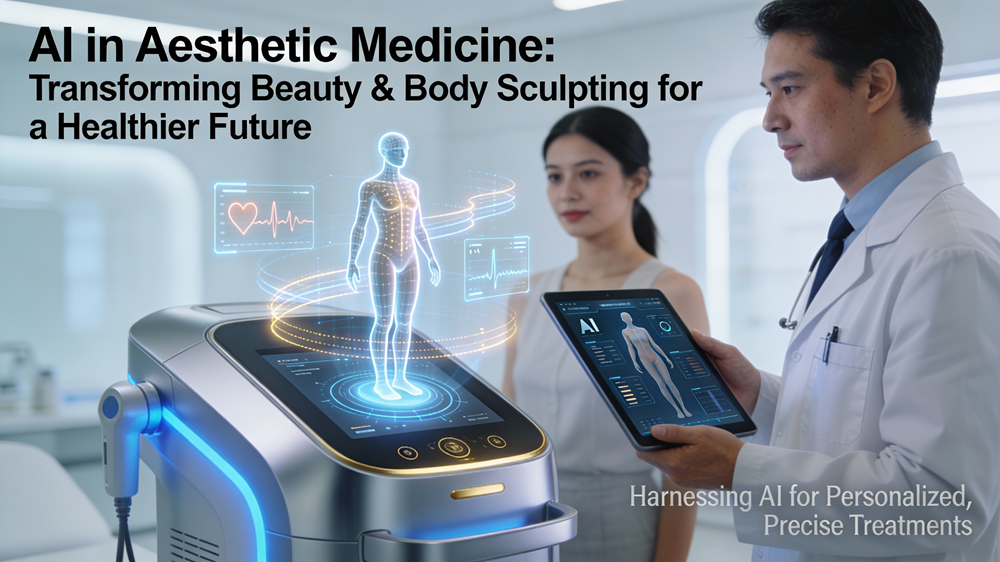
AI skin analysis apps, AI coaches for fat loss, virtual beauty consultants, smart fitness trackers. It’s all here. The moment someone builds a real “Dr. House” AI, it’s going to be a breakout hit.
Right now, AI for beauty and aesthetics is getting crowded. Some people are turning ChatGPT into their dermatologist. Others have built their own personal nutrition coach or “AI anti-aging plan.”
And while we keep saying that AI can’t replace real doctors, we all knew this moment was coming. The question now is: how are cosmetic doctors actually using AI?
Yes, we use artificial intelligence in medicine for skin analysis and treatment planning, but not in the same way the average person does. We’re talking about medical-grade AI tools made for trained professionals.
So let me walk you through what AI in skin care, body sculpting, and aesthetic medicine really looks like today. And of course, we’ll take a peek at what’s coming next.
What is AI in Aesthetic Medicine?
AI in aesthetic medicine is helping us personalize treatments like never before. Cosmetic surgeons, dermatologists, and clinicians can now make more informed decisions about skin care, hair restoration, and rejuvenation treatments.
Think about this: The amount of data we can collect from the body today is incredible. What artificial intelligence in medicine has changed is how we analyze all that information. Instead of relying only on generalized protocols, AI can compare thousands of cases and help us understand what might work best for your skin, your tissue, and your goals.
We may finally be leaving the “one cure fits all” era behind. For example, AI for skin care can support dermatologists in selecting the right actives or prescription-strength products, at the right concentrations, for the right skin type.
AI technology for health is absolutely helping doctors be more precise.
For clinicians and surgeons, this means faster, more detailed diagnostics and clearer insights into whether a patient is a good candidate for a procedure. And yes, there are powerful, FDA-cleared AI tools already changing how we work.
But how are we doctors using these AI tools?
AI WorkFlow in Aesthetic Medicine
I recently read this article about AI in cosmetic medicine, and I liked how the authors summarized the current workflow. They broke it down into four simple steps:
- Patient Assessment: This is where everything starts. The doctor reviews the patient’s goals, medical history, photos, lifestyle, and overall condition. It’s also where we determine if someone is a good candidate for a specific body contouring or skin treatment.
- AI-Based Imaging and Analysis: With specialized AI imaging, we can scan the skin or treatment area in much more detail. These tools highlight patterns we might miss with the naked eye and give us extra data to make better decisions.
- Diagnosis and Treatment Planning: Based on the AI analysis, doctors can simulate outcomes, identify ideal treatment zones, estimate risks, and build a personalized plan. It’s like a forecast that helps us validate or refine how we want to treat.
- Follow-Up and Monitoring: AI tools help track healing after a procedure. They can flag early changes, help document progress, and make follow-ups smoother for both the patient and the doctor.
As you can see, cosmetic treatments aren’t even close to being automated by A. Procedures are still performed by trained doctors and licensed technicians. What AI is changing is diagnostics, planning, and precision.
Also, ask any doctor the value of automated tools for patient experience and follow up. They’ll tell you that, as simple as it sounds, it’s a game changer. Appointment reminders, check-ins, follow-ups, and secure communication. All those things can really make a doctor’s practice way more effective.
AI in Health & Beauty
AI-Powered skin analysis, biomarker mapping, big data, smart wearables. All this beauty and health tech today is powerful, but that’s exactly what they are: tools. They’re not meant for patients to diagnose themselves or choose treatments on their own.
As I said earlier, AI helps clinicians, dermatologists, and cosmetic surgeons do our jobs with more precision. But AI shouldn’t be guiding treatments without a trained professional interpreting the data.
So let’s talk about what everyone wants to know: how AI is being used in real anti-aging and beauty treatments today.
AI-Powered Skin Analysis Apps & Machines
There are two big categories of AI-powered skin analysis:
- Consumer apps
- Medical-grade imaging machines
Both use algorithms, but as you’d guess, the clinical systems take skin diagnostics to a much deeper level. Here’s how they generally work:
AI-Powered Skin Analysis Apps are everywhere now. You upload a photo, and the AI gives you a basic read on your skin health, aging markers, and overall condition. With how used we are to Instagram filters, it’s no surprise these apps became a hit.
They’re also far more accurate than a simple online questionnaire. Most people don’t even know their real skin type. Oily or dry? Both? These apps help point them in the right direction.
With medical-Grade AI Facial Analysis Machines, things get more serious. These systems give dermatologists and cosmetic doctors high-precision data that’s hard to spot even for an expert human eye.
AI can scan for:
- Skin health markers
- Redness & inflammation
- Oiliness
- Moisture levels
- Sun spots
- Wrinkles & fine lines
- Texture quality
- Dark circles
With that information, a doctor can decide the best treatment: RF, microneedling, chemical peels, lasers. Or yes, even our brand-new Sofwave anti-aging treatment.
Plus, AI-powered “before & after” imaging is incredibly helpful. Patients see measurable improvements, and doctors can track progress with objective data.
Robotic hair transplantation
I think that robotic hair transplantation will become something really big in the future. Modern robotic FUE systems use AI to map the donor area with higher precision. This helps with consistent graft extraction, reduces over-harvesting, and can even shorten recovery.
How can AI improve hair transplant procedures?
- The robot extracts follicles faster
- The surgeon supervises, adjusts settings, and monitors progress
- The repetitive, fatigue-inducing tasks are handled by the machine
The patient can get a faster and more precise treatment, and the surgeon can avoid fatigue during long sessions.
But robotic hair transplant systems still have their limitations: they can only extract from the back of the scalp. This means they cannot harvest from the sides, neck, beard, or chest. For those areas, you still have to go with a trained surgeon using a motorized FUE device.
And another fun reality check: Robots struggle with curly or coily hair. AI hasn’t mastered curls yet. So I think human hair surgeons are going to continue being the real MVP for hair recovery.
Health Dashboards & Predictive Modeling
Let’s now get into body sculpting procedures. Before any cosmetic procedure, like liposuction, Renuvion, or plastic surgery, we need full pre-operative studies: labs, imaging, heart tests, metabolic panels, BMI, and more.
This is where AI in healthcare is incredibly helpful. It can analyze patient data faster and with more granularity than manual review. That means:
- Better risk assessment
- More accurate diagnoses
- More personalized treatment plans
- A clearer picture of expected outcomes
AI doesn’t make decisions for us, and we plan to keep it that way. But as it processes data so we doctors can make better decisions.
I touched on this in my podcast recently: AI can evaluate CT scans, MRIs, metabolic panels, EKGs, ultrasounds, and even body composition scans with a level of detail that’s hard for the human eye to match. That allows us to personalize body sculpting, weight-loss treatments, and anti-aging protocols far more effectively than we used to.
AI & the Future of Health & Wellness

What about “Lipo AI”? Are we there yet? Well… not exactly.Yes, there are AI-assisted liposuction tools available. But the surgeon’s hands, skill, judgment, and experience, are still the main event.
At True Contour, VASER liposuction remains one of the gold standards for precision body sculpting. But that doesn’t mean AI won’t influence how we approach liposuction in the future.
So what can AI do for us right now? A lot.
AI helps us build a more thorough and personalized pre-operative assessment. It can analyze bloodwork, labs, metabolic data, and imaging studies like X-rays, CT scans, and MRIs with impressive detail. This is where AI for health monitoring really shines:
- Better preparation
- Better screening
- Better predictions
- And more realistic treatment modeling
I see a huge opportunity here, especially for prevention, safety, and creating before-and-after simulations based on real data.
And then there’s aftercare, where AI can completely change the game. Wearables and smart sensors could help track hydration, activity levels, compression garment use, inflammation patterns, and healing progress with far more precision than a quick check-in.
I always tell my patients: Post-op follow-up is critical in any aesthetic procedure, and AI-supported monitoring could make the entire recovery process smoother and safer.
Having this level of refined pre-op and post-op analysis can help us plan everything better, from where we harvest fat, to how much, to how we sculpt specific areas.
Will AI one day assist inside the operating room? Maybe. But right now, liposuction is still quite literally in the surgeon’s hands.
Why Choose True Contour Medical?
At True Contour Medical, we stay up to date with the best techniques, the latest technology, and the innovations that actually make a difference for patients. And of course I’ve been following what AI can do in medicine closely. Who wouldn’t?
But one thing hasn’t changed: it’s never a good idea to take medical or aesthetic advice directly from an AI model. As I’ve said in a previous post about AI in medicine, tools like ChatGPT or Grok can explain procedures like Renuvion or liposuction in broad terms, but they don’t really know you.
Patients come to our office every week, and we often get to see what “their AI” suggested. Believe me, going with those recommendations without checking with your doctors is never a good call.
So if you’re considering a skin, body, or anti-aging treatment, bring your questions, bring your goals, and yes, bring your custom GPT if you want. We’ll treat it nicely.Whenever you’re ready to start your journey, schedule a consultation with us. We’ll help you get the expert, personalized care you deserve.