
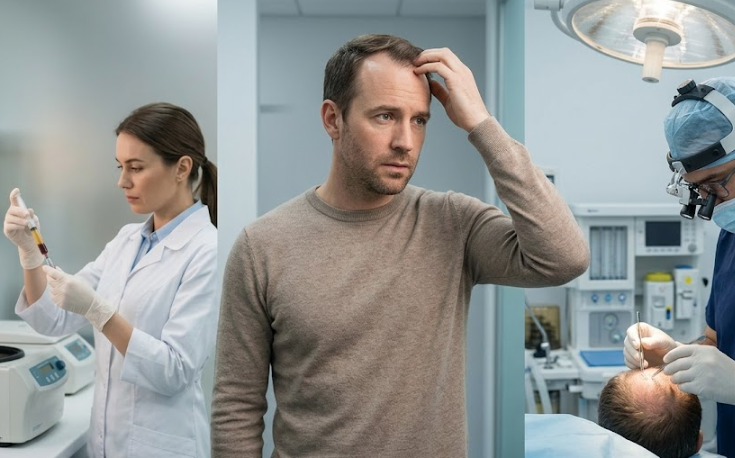
Today, hair loss treatments have advanced a lot, thanks to innovations like PRP and modern hair transplant techniques. Really, this isn’t hype. While alopecia is a chronic condition and remains with no definitive cure, the options available today are far more sophisticated than they were even a decade ago.
Minoxidil remains an FDA-approved cornerstone treatment, but today it’s only one part of the solution. Regenerative treatments like PRP have introduced new ways to support thinning hair, while modern hair transplant techniques continue to improve how we restore density in more advanced cases.
And that’s exactly what we’ll review today: two of the most talked-about hair restoration treatments available, PRP and hair transplants. If you’re trying to decide which approach may be right for you, keep reading as we explore the differences, the benefits, and what we see in clinical practice.
What Is a PRP Hair Treatment?
A PRP hair treatment is one of the most popular regenerative medicine approaches for hair loss. Instead of relying on medications or surgery, we use growth factors from your own blood to help support healthier, stronger hair follicles.
The process for a PRP hair treatment is straightforward:
- We draw a small sample of blood.
- We concentrate the platelet-rich plasma through a centrifuge process.
- We apply local anesthesia to the scalp for comfort.
- We inject the PRP into areas where the hair is thinning.
Most patients return to their usual routine the same day, and the treatment is usually very well tolerated.
So, what’s the science behind this hair loss treatment? The platelets in PRP contain growth factors that help stimulate the scalp environment and encourage follicles to remain active for longer. These PRP injections can improve hair density, strengthen existing hairs, and support long-term hair growth in patients who still have viable follicles.
But as we already said, Alopecia is a chronic condition, which means it usually requires ongoing care. For PRP, we typically recommend an initial series of sessions once a month, depending on the patient’s hair loss pattern and response to treatment.
Good candidates for PRP hair treatments include patients who:
- Are in the early stages of alopecia
- Have experienced side effects from medications like minoxidil or finasteride
- Those who have recently undergone a hair transplant.
PRP is considered very safe because it comes from the patient’s own blood. And when we start treatment early enough, it can become an important tool for long-term hair recovery. As we explain in our guide to PRP for Hair Loss, the goal of this treatment is to strengthen thinning hair, improve hair density, and help existing follicles remain active.
Which brings me to this: For patients with more advanced thinning, treatment goals usually shift toward a different procedure. Let’s go over that next.
What Is a Hair Transplant?
A hair transplant is the treatment we typically consider for patients with more significant hair loss. In simple terms, surgeons take healthy hair follicles from a donor area, usually the back and sides of the scalp, and transplant them into areas where hair has become thin or sparse.
Modern hair transplant techniques can restore hair density in areas that have already experienced significant hair loss. As alopecia remains an ongoing process, many patients explore complementary treatments such as PRP after a hair transplant. But we’ll get to that later.
Today, surgeons perform hair transplants using two main techniques: FUT and FUE. Both relocate healthy follicles from one area to another, but they differ in how those follicles are harvested and prepared.
FUT, or the Hair Strip Method
FUT (Follicular Unit Transplantation) is also known as the strip technique. The surgeon removes a strip of hair-bearing scalp, usually from the back of the head, separates it into individual follicular units, and transplants those follicles into areas affected by hair loss.
Because FUT involves an incision and stitches, it leaves a linear scar in the donor area. The advantage is that it can provide a large number of grafts in a single procedure, making it an option for patients with more extensive hair loss.
FUE, or the Hair-by-Hair Method
FUE (Follicular Unit Extraction) is the most popular hair transplant technique today. Instead of removing a strip of scalp, the surgeon harvests hair follicles individually and implants them into thinning areas.
The procedure usually takes longer than FUT, but it avoids a linear scar and often offers a quicker recovery. FUE can also use donor hair from areas such as the beard or chest when appropriate.
PRP vs Hair Transplant: Key Differences
So know that went over what PRP for hair loss and hair transplants are, it’s time for a side-by-side comparison:
| PRP Hair Treatment | Hair Transplant | |
| Type of Procedure | Regenerative medicine treatment using growth factors from your own blood | Surgical procedure that relocates hair follicles |
| How It Helps | Strengthen existing follicles and improve hair density | Restore hair to areas with significant hair loss |
| Best Candidates | Early-stage hair loss and thinning hair | Moderate to advanced hair loss |
| Invasiveness | Minimally invasive injections | Surgical procedure |
| Downtime | Little to no downtime | Recovery period required |
| Maintenance | Periodic maintenance sessions recommended | Often combined with medical or regenerative treatments to support long-term results |
| Results | Gradual improvements in hair density and hair quality that develop naturally over time | Can provide significant restoration of hair density, but natural results depend more on factors such as technique, technology, and healing |
PRP for Hair Loss vs Hair Transplant: Which One Is Best?

The truth is that PRP and hair transplants are not really trying to solve the same problem. In many cases, they can work quite well together.
With PRP, we focus on strengthening existing hair follicles, improving hair density, and helping thinning hairs stay active for longer. A hair transplant, on the other hand, restores density by relocating healthy follicles into areas where hair loss has already become more advanced.
Both these treatments are often complementary, and the sooner patients explore their options, the better. This is especially true for patients with a personal or family history of alopecia, where a long-term plan can make a meaningful difference.
Patients who received PRP alongside a hair transplant experienced improvements in hair density, follicle survival, and the early growth of transplanted hairs compared to transplant procedures alone.
In fact, research backs this up. Studies have found better follicle survival when PRP is combined with hair transplantation, with one reporting survival rates of about 82% with PRP versus 74% without it.
So even after surgery, hair restoration is not always a one-off treatment. PRP can complement a hair transplant by supporting the follicles, helping maintain hair density, and encouraging more natural-looking results over time.
Patients in the early stages of alopecia often benefit from a regenerative approach like PRP.
Patients with more significant hair loss may still need a transplant to restore density. And for many patients, PRP becomes a smart add-on to support the long-term plan.
Of course, treatment plans also need to fit real-world considerations like recovery time, lifestyle, and budget. Hair transplants typically involve a larger upfront investment, while PRP requires a series of treatments and ongoing maintenance.
Making the Best Decision for Long-Term Hair Restoration
So, what’s better: PRP or a hair transplant? Depending on your stage of alopecia, your goals, and your long-term plan, one approach may make more sense, or you may benefit from both.
But the only way to tell is with a personalized evaluation. Hair loss is different for every patient. The pattern, the progression, the quality of the donor hair, your medical history, and even your lifestyle all play a role in determining the best strategy.
At True Contour, we’ve spent more than 20 years helping patients navigate cosmetic and regenerative treatments. If you’re concerned about hair loss and want to understand your options, schedule a consultation with us. We’ll evaluate your hair loss, answer your questions, and help you build a personalized science-based plan for long-term hair restoration.