
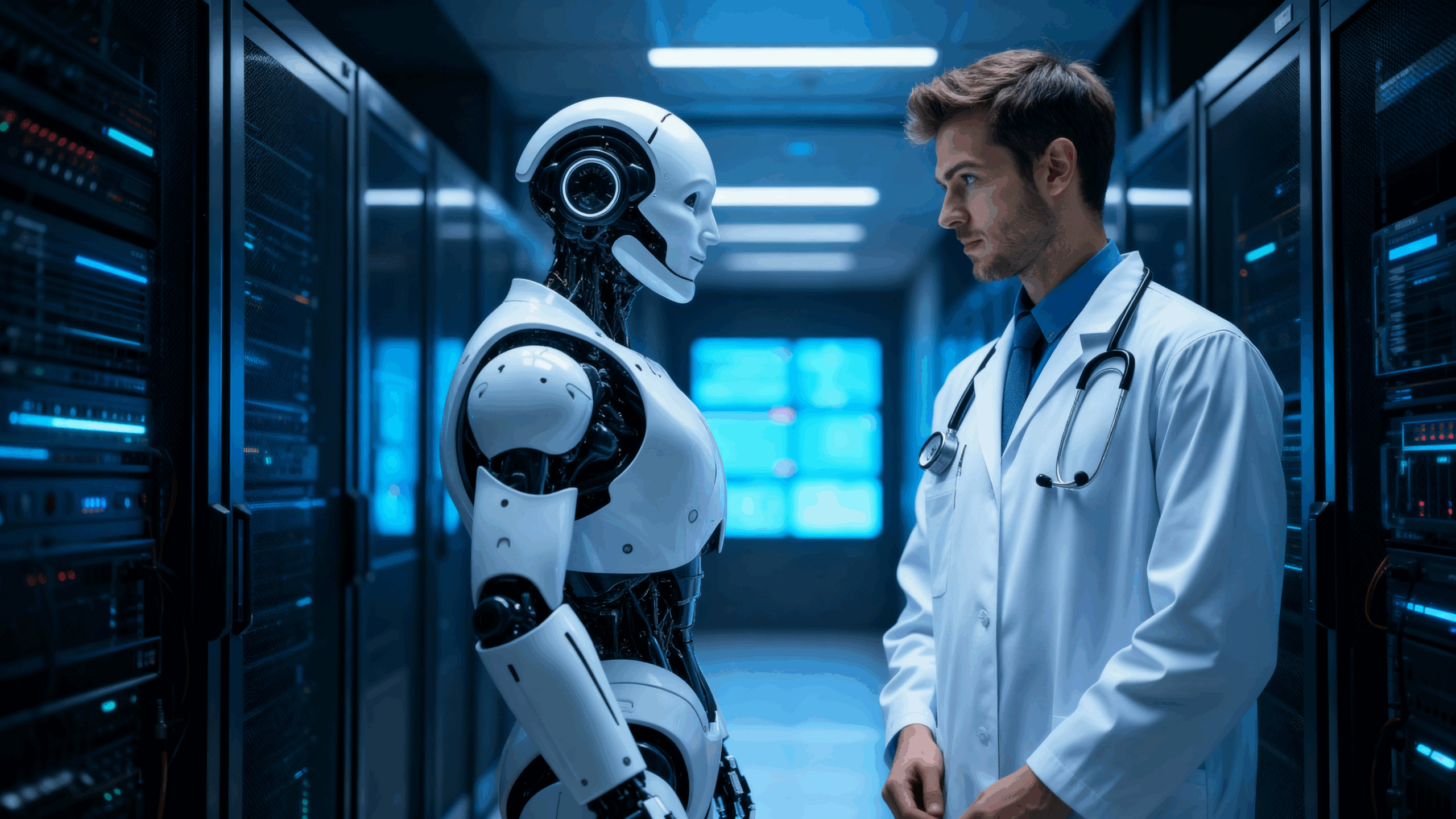
“AI won’t replace humans. But humans with AI will replace humans without AI”. This is a quote from Harvard professor Karim Lakhani, and it hits especially hard in medicine.
It’s the “Will AI replace doctors?” question. We even talk about this among colleagues, but not in the way people imagine.
Behind the scenes, AI in healthcare is already helping us with imaging, diagnosis, health tracking, and faster clinical decisions. It’s becoming part of the toolbox, but certainly not the doctor.
Does this mean we’re heading toward a future where AI medical diagnosis replaces the need for human doctors entirely? No, I don’t think so. Medicine has always been deeply human. We talk to patients and make decisions with judgment, ethics, and experience. That’s something that AI just can’t do.
So no, ChatGPT, Grok, or Gemini shouldn’t be your primary doctor. But AI does have a place. Let me show you how we human doctors are integrating it into our daily practice to truly make a difference.
Understanding AI in Healthcare
AI in healthcare is expanding what doctors can do. It helps us identify conditions earlier, validate treatments with stronger research, and be more precise with diagnosis and expected outcomes.
How are doctors using AI? By speeding up access to insights that help us diagnose and treat more accurately: advanced imaging, rapid science-backed search, and improved interpretation of patient’s health indicators
Human doctors bring judgment, context, and the ability to connect dots beyond raw statistics. AI brings speed, pattern recognition, and access to massive amounts of medical data.
Here’s what AI is actually doing in medicine today:
AI for Radiology and Predictive Care
AI has changed the way radiologists work with CAT scans, MRIs, mammograms, and chest X-rays. It can analyze images in seconds and detect patterns so subtle the human eye might miss them.
AI can spot early signs of strokes, lung diseases, tumors, and even cardiovascular issues long before symptoms show up. That kind of early detection gives doctors a huge head start that can save a patient.
Here I’d like to stop for a minute and talk about AI for predictive breast cancer screening. Some AI tools can look at a normal mammogram and say, “Everything is fine today, but these specific areas have a high chance of developing into breast cancer.” Doctors have followed up with biopsies in cases like this… and actually found cancer cells that hadn’t developed yet.
In fact, JAMA Network shared an extensive study showing that certain AI algorithms can detect breast cancer 4–6 years before traditional methods. In oncology, early detection is everything.
It sounds like science fiction, but no; AI against breast cancer is already here. And this is one of the areas where we hope AI will truly save lives.
Real-Time Monitoring
Two things are completely changing how we follow patients: wearable tech and AI.
Today, a smartwatch can track blood oxygen, heart rate, glucose trends, stress levels, and make a whole panel of biomarkers. On its own, that data is interesting. With AI? It becomes a 24/7 analysis tool that can detect patterns, alert about irregular changes, and predict when something might go wrong.
A great example is seizure detection for epilepsy patients. AI-powered wearables can recognize the early signs of a seizure and notify the user or caregiver. Just a few years ago, this simply wasn’t possible.
But here’s more: The American Heart Association recently published an article on how AI combined with wearable tech can detect arrhythmias early, including risks for stroke and heart failure. Some of these algorithms were trained on over 266,000 12-lead ECG recordings, and then connected with smartwatch sensors.
This doesn’t just change how we manage these conditions. It also gives patients a new level of insight and control.
AI for Clinical Decision Support (CDS)
Now, here’s where AI can transform both everyday care and emergency medicine: instant access to evidence-backed cases and research.
Take a platform like Open Evidence. It’s an AI copilot designed specifically for medical professionals. It puts thousands of case studies, clinical papers, and evidence-based answers right at our fingertips.
How much does this help with high-stakes decisions? Think of it as expanding a second opinion from one colleague… to thousands.
It’s a bit like being at a medical congress where doctors share cases, discoveries, and new treatments. Except now, that knowledge is available instantly, exactly when we need it.
For us in the medical community, access to what other clinicians have learned is invaluable. But like any giant library, you need to understand how to interpret what you’re reading. And that’s why human doctors remain essential.
Specialized AI for healthcare is very different from ChatGPT, Grok, or Gemini. Consumer models are generalists. CDS tools are trained on medical publications, guidelines, and peer-reviewed science. This makes a world of difference.
Can AI Replace Doctors?
Rather than AI substituting human doctors, I see things this way:
“AI won’t replace doctors. But doctors who use AI will set the new standard of care.”
What I mean with this is that the human doctors vs AI debate it’s false. It’s not a competition, it’s much needed collaboration. Doctors can use AI tools to improve accuracy, speed up diagnosis, and ultimately take better care of patients.
Let me put it this way: Would you trust an AI doctor over a certified, trained human doctor? Or would you want them working together as a team?
AI can process data, compare thousands of cases, and deliver insights in seconds. But it still needs a trained doctor to interpret that information, understand your history, and make the right medical decision.
Any model like ChatGPT, Gemini, or Grok can give you a list of possible conditions based on symptoms. But if you don’t know how to interpret that correctly, you can easily misdiagnose yourself or take the wrong medication. It’s the same problem we see with self-medicating or following advice from random health influencers online.
People search for real physicians because medicine is not just information. You also need interpretation.
We’ve all heard the warning: don’t Google your symptoms. Well, the same applies to relying on an “AI doctor.” It’s a powerful tool, but only when guided by someone who understands the science behind the symptoms and the person behind the patient.
It can speed things up. It can catch details we might not see right away. But you still need your physician, the doctor who knows your medical history, understands your unique context, and can guide you safely.
AI + Doctors = The Best of Both Worlds
I know AI is a hot topic for every profession right now. But health is especially sensitive, because medical data on its own still needs human judgment and empathy.
I talked about this on my podcast, Late Nights with Dr. G (you can watch it here!): Doctors know what to ask an AI for, how to ask it, and how to recognize when something the AI suggests doesn’t add up.
AI is only as good as the person guiding it. It depends on how you prompt it, refine it, and evaluate its output.
After all, AI is trained on human experience and research. But making sense of it and applying it safely, still requires a trained physician.
Now, when AI and human doctors work together, that’s where healthcare truly levels up. Here’s what that looks like:
- Faster, more detailed imaging insights: AI provides rapid analysis of MRIs, CT scans, and ultrasounds. Doctors then use that information to give more accurate treatment recommendations.
- Better preventive medicine: AI can flag potential issues long before symptoms appear. Doctors can act sooner, improving outcomes for conditions like heart disease, cancer, diabetes, and more.
- Instant Access to extensive clinical research: Instead of spending weeks digging through studies, doctors can get evidence-backed guidance in seconds. But again, only a trained doctor can interpret which findings matter most for a specific patient.
- More access to healthcare in rural areas: Not every small town has a radiologist or specialist on site. AI tools can help local clinics get faster insights, so patients don’t have to wait days for a diagnosis.
- Major help with administrative tasks: Documentation, coding, insurance paperwork, scheduling — AI can handle a huge part of this. And trust me, anything that frees up time allows us to focus more on patient care.
AI for Health & Beauty Centers
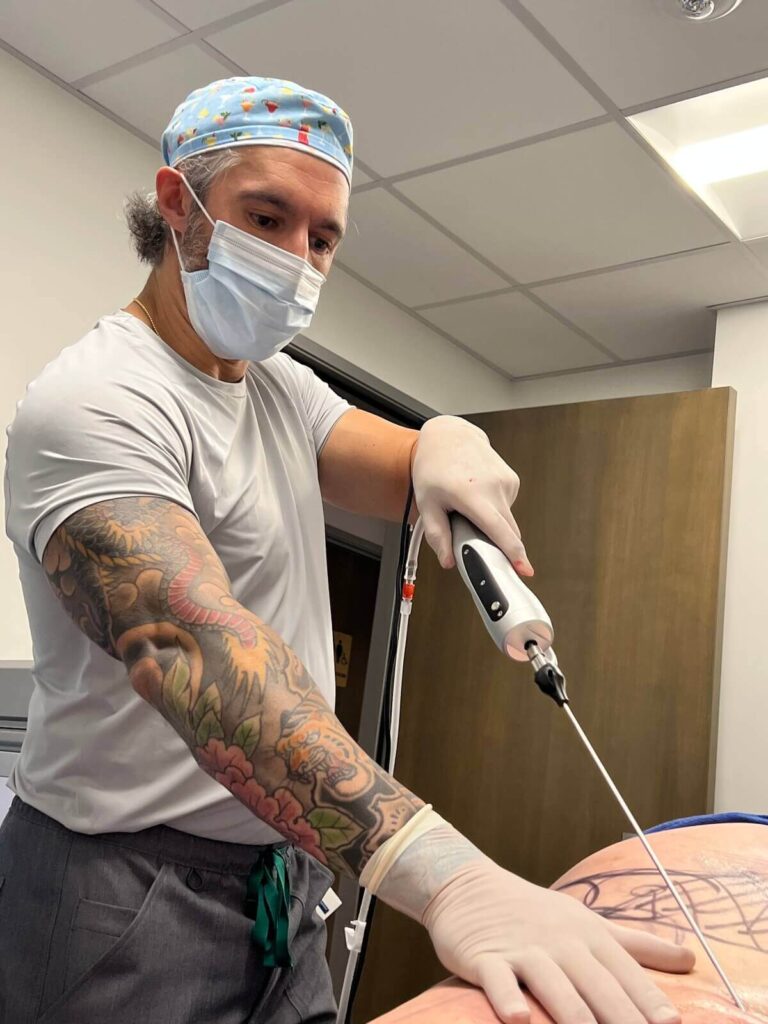
I’ve been doing pain management, regenerative medicine, and liposuction for over 20 years now, and here’s my honest take: AI isn’t replacing surgeons anytime soon. We still need expert hands, skilled judgment, and real-time decision-making in the operating room.
Surgical equipment keeps getting more advanced and precise, but at the end of the day, a surgeon still needs to operate the tools. That’s not changing.
Where do I see AI shining? In assisting us with precision.
If we can get better scans, more detailed imaging, and deeper insight before a procedure, we can take treatments like HD liposuction to the next level.
Back in the 70s, liposuction was a completely different surgery. More invasive, more traumatic, and much harder on patients. Today, with the right technology, we’ve turned it into a minimally invasive sculpting procedure.
At True Contour, we use PAL Liposuction and VASER liposuction, power-assisted technologies that let us sculpt more accurately while being gentle on the tissue. The tech is amazing, and patients ask for it. But what really shines in each review and comment it’s our expert training, it’s in our hands, and our human approach.
What am I expecting? AI in cosmetic surgery is moving toward things like:
- more precise fat grafting
- predictive analysis for aesthetic outcomes
- sharper, more detailed imaging before procedures
Cosmetic procedures have been improving for years. As machines and techniques evolved, we were able to work with less trauma, shorter downtime, and more precise outcomes.
How AI Will Shape The Future of Healthcare
Human doctors vs AI? Switch the vs for a plus sign: AI + Doctors. I think that at some point, AI will simply become part of how we practice medicine.
AI can help us expand access to care, improve people’s quality of life, and maybe even help us live longer. If the last few decades were all about collecting data, this next era is about actually understanding it, and using it faster.
But here’s the most important part: medicine isn’t a perfect science. More data doesn’t magically give you the right answer.
Just like a plane still needs a pilot, healthcare still needs real doctors making real decisions.And if you’re thinking about starting your body sculpting journey, here’s how AI can help: ask it to schedule a consultation here at True Contour. Tell it you’re looking for “the best cosmetic surgeon in Scottsdale”, by now your favorite model probably knows about us anyway.